
Palo Alto, CA · Tankless Water Heaters · Install and Repair
Tankless Water Heaters in Palo Alto, CA: Will Your Gas Line and Electrical Panel Handle One?
Hot water that never runs out is the reason most people want a tankless heater, and it mostly delivers. Whether it works well in your house comes down to three things worth settling before anything is ordered: the flow it has to supply, the gas or electrical service behind it, and how it is maintained. Tankless water heater services in Palo Alto, CA start with sizing, venting and whether the gas line and electrical panel can carry the unit.
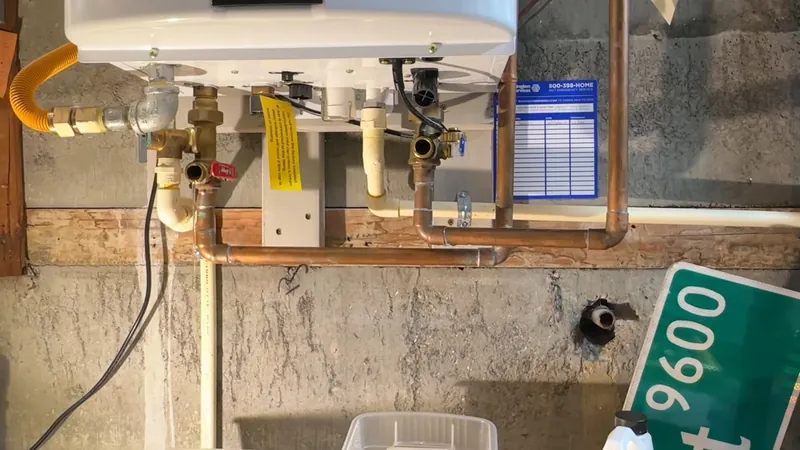
What a tankless heater does well, and where it struggles
A tankless unit heats water only as it flows through, so there is no stored tank to run dry and no standby heat loss from a tank sitting warm all day. It is compact, it can mount on a wall inside or outside, and it frees the floor space a tank takes up.
Its limits come from the same design. It has to heat cold water instantly, so it can only supply so much at once. Very small draws, like a trickle at a basin, can fall below the minimum flow needed to fire the burner. And when one tap shuts and another opens quickly, a short burst of cooler water can come through before the unit catches up.
Sizing by flow, not by tank size
A tank is sized in gallons stored. A tankless heater is sized in gallons per minute at a given temperature rise, which is the number of degrees it has to lift incoming cold water to reach the temperature you want at the tap.
- List the fixtures likely to run at the same time on a busy morning: two showers and a dishwasher, for example.
- Add up their combined flow rate from the fixtures' own ratings.
- Work out the temperature rise from your incoming water temperature to your set point.
- Choose a unit whose rated output at that rise covers the combined flow, with some margin.
Undersize it and the second shower runs lukewarm. That is the most common complaint about tankless systems, and it is a sizing problem, not a fault with the technology.
Not sure what size you need? Describe the household and we will work it out.
Call (833) 840-2034The gas line and the vent usually decide the job
A gas tankless heater burns far more gas at full output than a tank does, so the existing gas line is often too small to feed it. Upsizing that supply, and running new venting to an outside wall or the roof, are commonly the largest parts of a conversion.
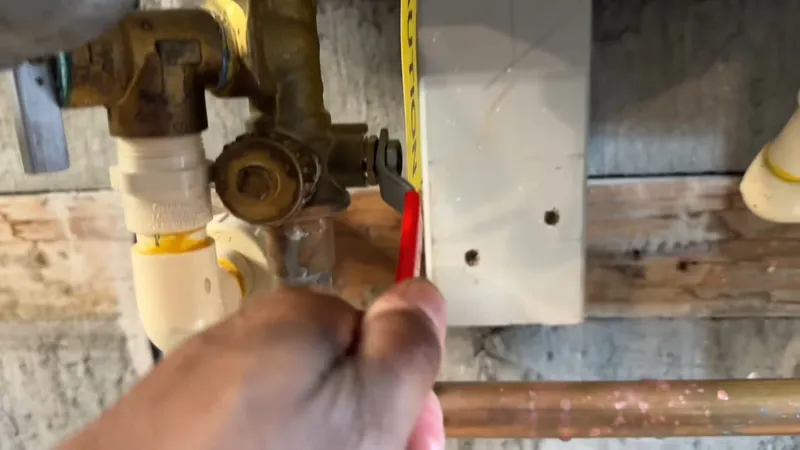
- Gas supply. The pipe from the meter has to carry the unit's full demand alongside every other gas appliance.
- Venting. Most units vent through dedicated pipe; condensing models can use plastic vent pipe and need a condensate drain.
- Electric units. A whole-house electric tankless heater draws a very large current, and the electrical panel often cannot supply it without an upgrade.
- Electric readiness. In Palo Alto, replacing a gas appliance can bring electric-readiness requirements under the city's current code.
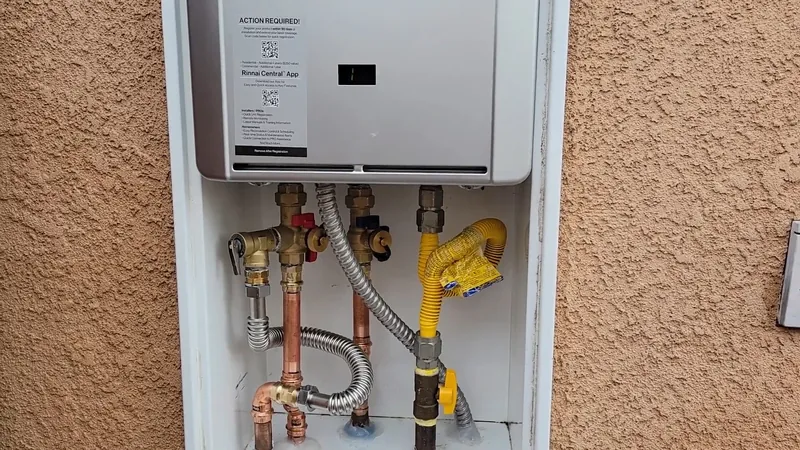
Point-of-use units under the sink
Not every tankless installation replaces the main water heater. A small undersink or point-of-use unit serves a single fixture, usually a basin or a kitchen sink at the far end of a long run from the main heater, where people wait a long time for hot water to arrive.
These are usually electric and small enough to fit inside a vanity. Some plug into a standard outlet; larger ones need a dedicated circuit. They are a practical fix for a remote bathroom or an addition, and they avoid running a new hot line across the house.
Descaling where the water is low in minerals
Mineral scale is the main enemy of a tankless heat exchanger, which is why manufacturers specify a regular flush, often once a year. Palo Alto has an advantage here. Its water, bought from the SFPUC regional system and drawn mainly from Hetch Hetchy, averaged 62 mg/L of hardness in the city's 2025 water quality report, roughly 3.6 grains per gallon, so scale builds far more slowly than in hard-water areas.
That does not make maintenance optional. The flush also clears sediment and debris, and the warranty usually depends on the manufacturer's schedule being followed. A properly installed unit has isolation valves on the water connections so the flush can be done without disconnecting anything.
When a tankless unit stops heating
Tankless heaters report most faults as an error code on the front panel, which is the first thing to note when you call. Common causes are an ignition or flame-sensing failure, a blocked air intake or vent, a flow sensor that is not detecting water movement, or a scaled or debris-blocked heat exchanger.
- Write down the error code before resetting anything
- Check whether the gas supply to other appliances is working
- Look at the outside vent termination for blockage
- Note whether the problem happens at every tap or only at low flow
Recirculation systems, which keep hot water moving to distant fixtures, add a pump and controls that can also fail, so mention one if you have it.
Error code on the panel? Call with it and we can often narrow it down on the phone.
Call (833) 840-2034Tankless or a tank: an honest comparison
| Tankless | Tank | |
|---|---|---|
| Installed cost, wide market range | About $2,500 to $4,800 | About $1,200 to $2,800 |
| Typical service life | Generally 18 to 25 years with regular descaling | Generally 8 to 12 years |
| Hot water supply | Continuous, up to its flow limit | Limited by tank size and recovery |
| Main install cost driver | Gas supply, venting or electrical capacity | Venting and code items |
Tankless usually costs more to install and less to run, and lasts longer. Whether that trade pays off depends on how long you plan to stay and how much infrastructure has to change. If a tank still suits you better, our water heater installation page covers gas and heat pump tanks.
Tankless water heater questions
Why does my tankless heater go hot, then cold, then hot again?
Usually because a tap was shut and reopened quickly, letting a slug of unheated water through before the burner relit. It can also happen at very low flows that fall below what the unit needs to stay lit. A recirculation system or a small buffer tank reduces it.
How much does a tankless water heater cost to install in Palo Alto?
Installation falls in a wide market range of about $2,500 to $4,800. The spread is mostly the gas line upgrade, the new venting and, for electric units, the electrical capacity. You get a written range once the existing gas or electrical service has been looked at.
Who should install a gas tankless heater?
A contractor holding a California C-36 plumbing license, since the job involves gas piping, venting and water connections. You can confirm a license on the Contractors State License Board's online lookup, and the installation normally needs a city permit and inspection.
How long does a tankless water heater last?
Generally 18 to 25 years when it is descaled and serviced on the manufacturer's schedule, compared with roughly 8 to 12 years for a tank. Palo Alto's low hardness helps, but skipped maintenance still shortens that life.
Can one tankless heater run two showers at once?
Yes, if it is sized for the combined flow at your temperature rise. If it was sized for one fixture, the second shower will run lukewarm. That is fixed by correct sizing, not by turning the temperature up.
Thinking about going tankless in Palo Alto?
Call and describe your household and your current setup. We will tell you whether your gas or electrical service can support it and give you a written range before anything is ordered.